What was new? What did you already know that was refined?
Computer-mediated discourse analysis was a new qualitative method for me, and perhaps my biggest takeaway from this class. As society continues to move deeper into utilizing digital devices as a main mode of communication, our ability to refine our research and analysis of these digital communications becomes more relevant.
Identifying that analysis can be done by simply evaluating “likes” or “hearts” or “smiley faces” was a new concept. The digital modes of communication are evolving and therefore research must evolve as well. Understanding that research analysis can be conducted through the social modalities of text messages, likes and tweets, and the undeterminded future forms of communication will keep me on my toes for my future research.
What methods were you most attracted to and why do you think that is?
The digital research modalities appealed to me most. Our communication methods are evolving, and therefore the research must evolve as well. Even the simplicity of the card sort analysis being transformed into a digital card sort process was appealing. I am more comfortable in creating digital tools, as compared to analog tools. In the card sort analysis example, I would find it cumbersome to write, cut, and sort physical cards. Yet, in the digital card sort analysis, one only needs to create the digital framework and that same framework can be quickly replicated. An analog card sort research project would take weeks to prepare depending on the number of participants, whereas the digital card sort process would only take a few hours.
Yet, as a researcher, we must always be curious, and thus my next question might be: Which modality is better, the analog card sort or the digital card sort? Which one provides more accurate results?
— humm…do I see a future study idea brewing? Perhaps.
Which methods are likely to be ones you use regularly in the future?
Unfortunately, I think the regular research in my future will default back to the traditional quantitative/qualitative analysis. As a researcher, I feel that to be taken seriously in academia, we must adhere to the traditional (boring) methods. Yet, I think this class opened my mind to considering other ways research can be collected and I hope that an opportunity arises where analyzing likes and tweets becomes the preferred measure.
This particular week the module focused on a classroom activity and not readings. Unfortunately, we did not get the opportunity to partake in the planned classroom activity, so my Reflection post will stay a bit from the expected review.
For this module, I honed into a subtle hyperlink that brought me to a page titled “Example brainstorming for labor distribution/etic codes.” My reflection will be focused on this page’s topic.
Etic knowledge refers to a widely accepted generalization about human behavior that commonly includes an individual’s culture or beliefs (Trommsdorff & Dansen, 2001). Etic questions are outsider observations and can be created based on one’s general understanding and/or research (Sinkovics & Alfoldi, 2012). The etic viewpoint is the opposite of the emic viewpoint which is an insider’s observation or perspective (Haapanen & Manninen, 2021).
The Canvas page titled “Example brainstorming for labor distribution/etic codes” contained nearly 20 etic question examples related to the topic of Second Life for qualitative research. From this question set, I identified 10 questions that may be relevant to my proposed research from the February 13th post regarding AI-generated images. I then altered the topic of those initial questions to be relevant to the AI-generated image topic.
Below are the potential etic questions related to the AI-generated image research:
How does the AI-generated image compare to a photographer’s image?
Efficiency of AI-generated image vs. photographer image?
Image AI-generation successes and failures?
Image AI-generation quality?
Identification of any patterns of the initial image set?
Stresses with AI-generated images?
Why use AI-generated images?
Satisfaction with AI-generated images?
Do you think others had similar views regarding AI-generated images?
What are the educational uses of AI-generated images?
References:
Haapanen, L., & Manninen, V. J. E. (2021). Etic and emic data production methods in the study of journalistic work practices: A systematic literature review. Journalism, 24(2), 418–435. https://doi.org/10.1177/14648849211016997
Sinkovics, R. R., & Alfoldi, E. A. (2012). Progressive focusing and trustworthiness in qualitative research. Management International Review, 52(6), 817–845. https://doi.org/10.1007/s11575-012-0140-5
Trommsdorff, G., & Dasen, P. (2001). Cross-cultural study of Education. International Encyclopedia of the Social & Behavioral Sciences, 3003–3007. https://doi.org/10.1016/b0-08-043076-7/02332-9
PROMPT: Describe the methods you explored and how you decided your top choice is best aligned to your potential dissertation topic. Post this in your blog.
Like many scholars, I have been enthused and overwhelmed by the current state of technology innovations with the recent introduction of ChatGPT to the commercial market. The limitless potential of generative artificial intelligence, combined with the nature of the open-source code, will forever change the technological landscape we know today.
Earlier this week I found myself falling deep into the rabbit hole of profile pictures created by an artificial intelligence agent. I was in need of a professional profile picture for my work and social media accounts, however, I was looking for a low-cost photographer that could capture a professional image of me that brought out my personality and was taken in a casual setting. My search for this “gem image” started about a year ago. I researched poses on Pinterest, waited for my hair to be styled just right, tried to identify locations that were casual yet professional, and then searched for a professional photographer that wouldn’t blow my budget. Needless to say, the search stalled.
In my search for an appropriate topic for this week’s post, I came across a news article that mentioned how the author discovered an AI generator that created professional portraits. I was intrigued…and down the rabbit hole I went. I discovered ProfilePicture.AI, and for the low-low cost of $8.00, I was able to entertain myself with AI-generated images of myself. While many of the image styles available were related to fictional characters such as anime, cyborgs, elves, or video game heroes, there were a few styles available that one would consider to be “normal.” Businessman, cafe, corporate, office, tropical, and winter were viable options for a professional headshot.
As part of the creation process, I uploaded 20 pictures of myself that had been previously taken over the last 5-7 years. I cropped out anyone who may be in the image beside me, and I zoomed in on my face in any images where I was further in the distance. Once my 20 images were ready, I uploaded them, selected my ideal styles, paid my $8.00, and waited. The inputted photos train the AI software to generate an appropriate output that accurately represents the user’s inputted images. A few hours later the program finished rendering my images and provided me with 116 unique profile pics that mostly looked like me.
This experience was quite fun, and although the sample collage above does not display all 116 images, I did include a few fun options of me as an astronaut and as Valkarie.
As I reflected on the potential of this technology, and knowing that it is in its infancy, I wondered if there could potentially be a research study that aligned with this fun tool. I research advanced qualitative research methods such as arts-based research, focus groups, usability testing, but these did not seem to align. Thus, I deflect back to a more traditional qualitative method of interviewing.
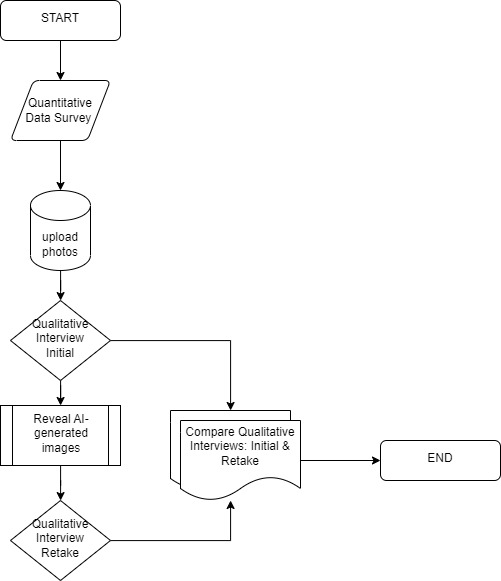
Yet, in this case, I am not sure that a solely qualitative research collection method would be sufficient and therefore I designed a mixed-methods research study for this research scenario. The mixed-method study would include a quantitative survey to collect confidence levels and trustworthiness of AI-generated images. A brief qualitative interview will be conducted following the survey completion, designed to gauge the participant’s feelings towards their ability to identify an AI-generated image, their feelings of deception as it relates to AI-generated images, factors that influence trust in an AI-generated image, and their feelings towards creator-transparency as it relates to AI-generated images. At the end of the survey, the participants will be asked to upload 20 face-pictures of themselves into a database maintained by the researcher. The researcher will preview the images and prepare them for the AI-generator software process by cropping any extra persons in the photo, as well as zooming in on any face pictures that are in the distance, before uploading them to ProfilePicture.AI. In the following one-to-two weeks, the participants will return to answer the same interview questions as they did prior; however, this time, they will be provided their AI-image renderings prior to the second instance of the interview. The interview responses will be evaluated to identify any changes pre-and-post receiving the AI-generated images of themselves. See the research method outline below:
In the end, I would expect that the qualitative interview responses will have changed between the pre-and-post interviews. I expect to see increased apprehension in their feelings of deception as it relates to AI-generated images, as well as trust factors for an increased number of online images. Additionally, I expect participants to express increased advocacy for creator-transparency of online images.
Research on this topic is slow in comparison to the lightning speed that the technology is advancing. Additional research needs to be conducted within the published literature to provide a foundation of support for this research topic.
The article “Computer-mediated discourse analysis: an approach to researching online communities” (Herring, 2004), discusses the importance of computer-mediated discourse analysis (CMDA) for researching online communities. The author explains how CMDA can be used to analyze communication patterns in online communities and understand how people use language to interact in these digital contexts. The article highlights the benefits of CMDA for analyzing large datasets, identifying linguistic features, and detecting patterns of interaction, power dynamics, and identity construction. The author also discusses the challenges of conducting CMDA, such as dealing with issues of privacy and data management, and provides guidance on how to conduct CMDA research effectively. Overall, the article emphasizes the value of CMDA for studying online communities and understanding the role of language in shaping digital communication.
CMDA can also be used to evaluate new and innovative technology areas, such as virtual reality (VR). CMDA analysis can focus on the types of language used in the social virtual reality environment, and how an individual wants their identity to be perceived in that virtual world. The analysis can be further stretched to evaluate an individual’s interactions, communications, and persona within the real world as compared to their VR identity.
Resources:
Herring, S. C. (2004). Computer-mediated discourse analysis. Designing for Virtual Communities in the Service of Learning, 338–376. https://doi.org/10.1017/cbo9780511805080.016
I went down a rabbit hole of how CMDA can be applied to conversations surrounding ChatGPT and other AI chatbots.
The article Data-driven artificial intelligence to automate researcher assessment (Weber & Duarte, 2021) presents a data-driven AI approach to automate researcher assessment by classifying candidate researchers as fit or unfit for a specific job placement. The approach adopts case-based reasoning, which allows adaptation, machine learning, and explainability. The methodology considers career trajectories and provides explanations, making it more accurate than purpose-independent classifiers. “…human decisions may be neither transparent nor reproducible. The approach in this article describes how to use AI methods to, from a job description, select the best fit candidates, while being transparent and reproducible.” The proposed approach addresses the limitations of human decision-making and ensures transparency, reproducibility, and accuracy in the assessment process.
I am familiar with AI technology being used to traverse a candidate’s resume and identifying keywords that align with the job description to help recruiters sift through large amounts of candidates to select those who might get an interview; however, what if the AI could also evaluate the interview conversation and further evaluate the potential candidates based on the live responses? While this article does not directly connect to my future research, I do find it extremely interesting that this potential now exists.
/
My search for “artificial intelligence to automate “qualitative” methods” also returned multiple software technologies that can be useful for researchers when evaluating qualitative research results:
I’m curious if anyone in the group has experience with any of these tools and learn how they were used for accdemic research.
I also found it interesting that the skill of qualitative research can be used in industry as well as education. Customer survey feedback responses will require significant qualitative skills to evaluate the potentially large amount of incoming respones data. In this case, an automated AI tool would be needed to be able to evaluate the data more quickly than what can be evaluated bya a human. However, I still believe thathuman-oversight will be necessary, as there could be errors within the survey coding or perhaps a unique circumstance arrose that affected the survey responses; an AI would not be aware of the abnormalities.
What appears to be useful?
This got me thinking about how we might be able to use qualitative research methods to evaluate conversations using AI tools and chatbots. I am intereted to see what types of questions are being asked of ChatGPT, and the depth of responses that are being provided. In my experience, the responses have been thorough, but lack the feel of humanism. While ChatGPT will directly tell you that it is not human, nor does it have human charastics, I feel that with a little bit of massaging we (society) could get more increased instances of human-like responses from ChatGPT. In this case I feel we can use the CMDA framework evaluate those conversations.
What may be challenging? Why?
In the aforementioned scenario of using the CMDA framework for ChatGPT conversations, the challenging component would be How do we get access to these ChatGPT conversations? Is OpenAI willing to share the data they’re gathering from their ChatGPT conversations? If so, there will likely be so much data that it will be near-impossible for a human to conduct the qualitative CMDA research, and we’d likly need an AI to conduct the research. It’s not lost on me that an AI would be conducting research related to humanistic conversational traights on another AI…seems ironic.
Are there specific settings in your own life as a researcher/practitioner where this may be the right method to answer your questions? Why or why not?
I’m not sure yet. I am engrossed with the firestorm of ChatGPT useage and OpenAI advancements, as well as it’s competitators. I am following this technology advancement closely, but there is so much coming all at once I am not quite sure where to start from a research perspective.
What is my general worldview in terms of what I think can be known, why that is the case, and how we can best understand the world?
What a deep question. We can only know what we choose to discover. The quantity of what can be known is limitless if we are willing to pursue our curiosities. The way we understand the world evolves with each speck of new knowledge we acquire.
What is research to me? What is its purpose? Do I prefer numbers or narratives or both?
Research is the pursuit of knowledge in understanding the why.
I prefer a mixed-methods research approach. I feel that some questions can be captured with numbers, while other questions require a narrative response.
What is your main focus in terms of what you are planning for future research? Are you interested in higher education, K-12, corporate, or other settings/topics? Are you looking to switch your focus to a new setting as you move forward in your career?
Currently, my main research focus is related to the impact of artificial intelligence in higher education. My research interests have waivered since being in the LTEC program with original interests in virtual reality for social connectivity, and now evolving into artificial intelligence. I am still very interested in virtual/augmented reality; however, over the last year, there have been massive layoffs within the major tech companies that influence the VR/AR landscape. These upsets are altering the progress of mixed reality development and motivations, and I feel that it may be wise to pause the VR/AR research due to the corporate turmoil.
I have been researching OpenAI for the last few months, and now this technology has exploded. Back in August when I originally started my research, I was hoping to be ahead of the game. Sadly, I was not as quick as the mainstream media and now there are more articles about OpenAI than I can count. I feel like I need to go back to the drawing board and find a new angle.
In my future career, I would like to be a voice for the future of innovative educational technologies. I would like for my ideas to be heard and to inspire others to push the boundaries of what’s possible. How does one become a “mover and a shaker”?