6240 – Discussion 3

What are two of the most significant ethical considerations we need to address in AI?

  1. I feel like the obvious and most significant concern is the potential for bias. AI systems can inherent bias from the content that they are trained on, which could potentially continue existing social, cultural, and historical biases. Being that generative AI is pre-trained on existing content it does not have the cognitive ability to ascertain the difference between what may have been socially acceptable 50 years ago, as compared to what is considered socially acceptable today. As society continues to evolve, and the ideals of mankind change over time, a concern is that AI may continue to communicate old standards that are not current with the laws of today’s society.
  2. Data privacy and protection, which is actually a topic I hadn’t considered prior to this course. As more and more applications are integrating AI, more and more data is being collected. The potential to use that data for harm, manipulation, or simply to sway consumer choice, is a significant concern to the future use of AI and the data the systems will be collecting. End User Agreements should become more transparent and simple enough for a layperson to understand. The TLDR (too long didn’t read) habits by users should go by the wayside, with increased data privacy measures and simple/transparent language.

How should these issues be addressed locally and globally?

Ethical and appropriate use of artificial intelligence should be a global movement. Regulations should be enacted, and experimental AI use cases should be monitored. Additionally, sanctions should be enforced if a country knowingly allows entities to break global regulations. Here, in the United States, limiting our AI innovations will only limit our progress and contributions to science and humankind. Unless there are global regulations, there is no point in regulating ourselves as we are now in an “arms race” of the 4th Industrial Revolution (Schwab, 2016).

Overall, What is your current ideological position on the evolving uses of AI in education, training, and the workforce?

Admittingly, I’m currently teetering. I have been a cheerleader, on the far end of optimism. Yet, after taking this course and reading Rouhiainen (2019), I’m concerned…and this actually is keeping me up at night. What are we going to do with all the people that will lose their jobs to AI? The current AI movement is happening and lightning speed and people are not just losing their jobs, but they are now being told that their trained skill is no longer valid in this economy. In the US much of our identity is wrapped into our trained skills and careers, what do we do when we’re told that the thing that we were proud of and the thing that made us feel fulfilled is dead? I was picking up lunch at Flame Broiler over the weekend and another customer was talking to her daughter on the phone. The speaker phone was on, and while it was annoying that someone would have their speakerphone up so loud in a restaurant, I couldn’t heal but overhear the conversation between the mother and daughter. The mother was sad that the daughter decided to attend college in a different state because they would be separated; but, the mother also understood that her daughter needed a good college education so that she could get a good career. In was an interesting conversation to forcefully eavesdrop while I was waiting for the worker to complete my food order. As the conversation progressed the daughter mentioned that she would be studying journalism. As soon as I heard this I wanted to jump through the phone and tell her “NO,” and tell her to select another major. She hadn’t even started her coursework, hasn’t been admitted, and she was about to enter a program that will educate her for a career that won’t likely exist when she graduates. Washburn (2023) is just one of the countless articles that report on the massive amount of media layoffs; layoffs likely a result of generative AI. What about the massive amount of student loan debt she is about to accrue? She won’t be able to pay her student loans because she graduated with a major in a field that was squashed by AI.

I am enthusiastically excited about the advancements in AI, but I am also extremely fearful of what it means to the global workforce.

References

Rouhiainen, L. (2019). Artificial Intelligence: 101 things you must know today about our future. Lasse Rouhiainen.

Schwab, K. (2016). The Fourth Industrial Revolution: What It Means and how to respond. World Economic Forum. https://www.weforum.org/agenda/2016/01/the-fourth-industrial-revolution-what-it-means-and-how-to-respond/

Washburn, E. (2023, May 20). 2023 media layoffs: Fox News Cuts Investigative Unit. Forbes. https://www.forbes.com/sites/emilywashburn/2023/05/09/2023-media-layoffs-mtv-news-shutting-down-as-paramount-media-networks-cuts-25-of-staff/?sh=6b9bf6f2b548
6240 – Assignment 1

Assignment 1 – Questions & Response

According to Rouhiainen, which is more difficult to process – structured or unstructured data and why?

Unstructured data is more difficult to process because it includes more complicated data such as images, videos, social media posts, shared links, digital communication, etc. This type of data is more difficult to analyze as compared to structured data because structured data typically includes simple numerical values (Rouhianinen, 2020).

Explain an application of Ambient Computing, the data the application is collecting, and how this impacts the user’s privacy.

Ambient computing is the idea that the physical computing device, as we know it, will disappear and become like background noise, transitioning into unnoticeable everyday items through a series of wired and wireless networks (Gunnarsdottir & Arribas-Ayllon, 2015; Weiser, 1995). Today, ambient has become something operating in the background. From our smartwatches to our home thermostats, to our Alexa devices and Apple Air tags, and even our dishwashers, everything is connected. This seamless integration of devices helps to make our lives easier, but what if this ambient data fell into the wrong hands? What if you had a stalker who now knew your every move, even inside your home where you are supposed to feel safe? What if foreign countries had access to the homes of our leadership? What if it was deemed by energy providers that you’re A/C was up too high, and they took control to lower it? Hackers could turn one’s own home into a weapon, locking someone inside as a prisoner, closing off all communication, and blasting the Baby Shark song repeatedly. What was once a haven, the home can now be controlled because everything is connected to the network; there is no more privacy.

Which industry will experience the most profound impact of AI and why?

Perhaps it’s just wishful thinking, but I hope that the most profound AI impact will affect education. Education has been the same for hundreds of years and hasn’t drastically changed from its roots. Now, with ChatGPT, educators are up-in-arms about the negative impact of technology and the ease of cheating potential. Yet, it begs the question, if a bot can pass your assignment, then how thoughtful was the assignment to begin with? With the new AI tools we have the opportunity to pivot and update the old ways of formal education; we can transition into a learning experience that is supported through research, discovery, creative thinking, and critical thinking skills. The 4th Industrial Revolution (IR 4.0) is upon us; “According to IR 4.0, technologies are fused and there are no solid lines between the physical, digital, and biological aspects of life (Elayyan, 2021, p. 24).” Previous industrial revolutions had a large impact on education including the development of career specialties, women and minorities being allowed to learn, mandated education for all, increased government support, and the establishment of higher education (Fenn, 2019). I am hopeful that the future of education will change as a result of AI.

Pick two experts that impressed you (from Chapter #1). Explain why they impressed you, and explain why you will follow their research.

  • Andrew Ng – I discovered Coursera a few years ago and was impressed with the structure of the online learning platform. The price point for the certificates made learning from top universities affordable to everyone. I have taken classes from Coursera and recommended classes to others. As an instructional designer, I was impressed by the microlearning structure of the course, the engaging activities and discussion opportunities, and the personalized learning approach to microcredeitnals. As soon as I read that Andrew Ng was one of the founders of Coursera, I was impressed and eager to learn more about him.
  • Fei-Fei Li – As one of the few women mentioned in the book as an Expert to Follow, I can only imagine the uphill struggle Dr. Li would have had on her journey to being the Director of AI Lab at Stanford. She has been given so many opportunities o learn, grow, and contribute to Stanford, Google, the Department of Defense, and started a non-profit. One would only hope to be so blessed.

Explain two reasons why AI has gained popularity in recent years.

AI has grown in popularity due to the increased media coverage. We must not omit that Generative AI, specifically ChatGPT, came out of the gate as a game-changer that brought real, conversational AI into the hands of millions. The increased media attention surrounding student cheating and academic ethics, plus the fear from early AI innovators has fueled the flames of a media circus circled around AI. (Bennett & Cuevas, 2023; O’Brian, 2023).

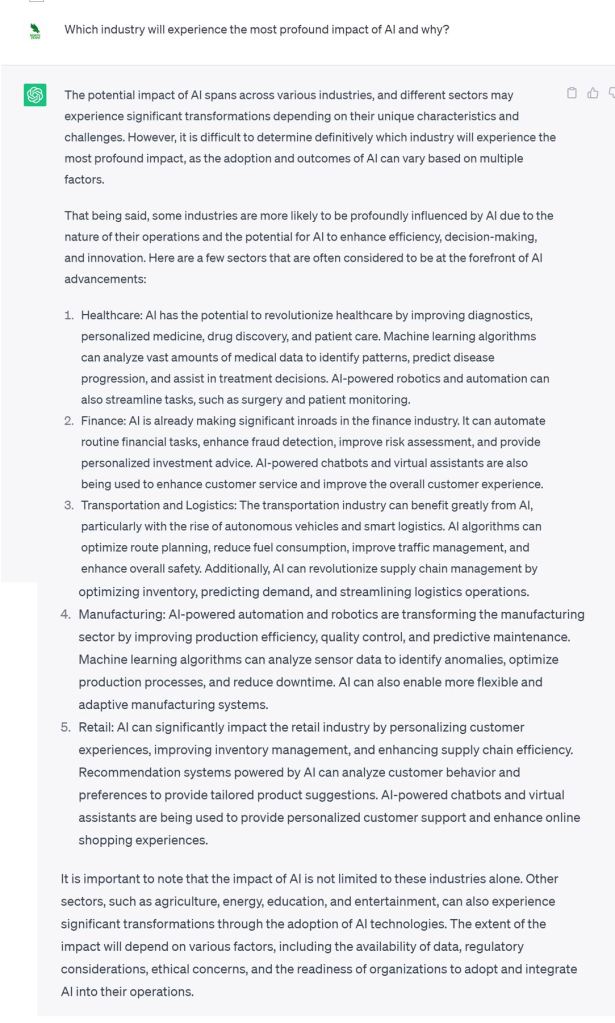
Choose one of the questions above and pose it to ChatGPT.  Post a screen capture of the response and explain the differences between your initial response and the response from this OpenAI tool.

I posed Question 3 in ChatGPT and the provided response is below. Upon reflection, my initial response only considered one option, education. My response to Question 3 was thoughtful, and personal, and had two citations. The ChatGPT response provided was matter-of-fact and written without any emotional consideration. It could be argued that there was “no thought” given to the question; the chatbot was merely looking to provide a reply. In fact, the topic of Education didn’t even make the list on ChatGPT’s response. Yet, in the early days of this technology, education was the primary industry directly influenced by the introduction of ChatGPT. Perhaps the chatbot got lost in the definition of the question stem? Or perhaps it was just looking for an answer? Either way, the response was not thoughtful and did not connect with the course, or my personal viewpoint.


References

Bennett, G., & Cuevas, K. (2023, May 5). “Godfather of AI” discusses dangers the developing technologies pose to society. PBS. https://www.pbs.org/newshour/show/godfather-of-ai-discusses-dangers-the-developing-technologies-pose-to-society

Elayyan, S. (2021). The future of education according to the Fourth Industrial Revolution. Journal of Educational Technology and Online Learning, 4(1), 23–30. https://doi.org/10.31681/jetol.737193

Fenn, J. (2019, December 16). Ways education was affected by the Industrial Revolution. Medium. https://medium.com/@johnbfenn/ways-education-was-affected-by-the-industrial-revolution-78644198dec3

Gunnarsdottir, K., & Arribas-Ayllon, M. (2015, June 18). Ambient intelligence: A narrative in search of users (discussion paper). Lancaster EPrints. https://eprints.lancs.ac.uk/id/eprint/74291/

O’Brien, M. (2023, May 15). Watch: Openai CEO Sam Altman testifies before Senate Judiciary Committee. PBS. https://www.pbs.org/newshour/politics/watch-live-openai-ceo-sam-altman-testifies-before-senate-judiciary-committee

Rouhiainen, L. (2020). Artificial Intelligence: 101 things you must know today about our future. Lasse Rouhiainen.

Weiser, M. (1995). The computer for the 21st Century. Readings in Human–Computer Interaction, 933–940. https://doi.org/10.1016/b978-0-08-051574-8.50097-2

6240 – Discussion 1

Prompt: Imagine that you have the task of preparing tomorrow’s workers for a retraining program.

  1. What would be the top five skills that you would have workers develop and why?How would you implement your training program?  

 Q1: What would be the top five skills that you would have workers develop and why? I believe we must reflect and consider what it means to be human. We must begin to identify how humans are different from AI and then strengthen the components that are uniquely human. In my research for this post, I discovered the following quote, which I feel is pertinent in guiding our future: “The value of AI might come not so much in making machines that act like humans, but stopping humans acting like machines (du Sautoy, 2019, p. 3).”While there are multiple skills that should be reevaluated in the Age of AI, the five skills I have selected include a mix of humanistic skills and technical skills.

  1. Interprofessional Skills – Huang et al. (2019) identify that managers need to adopt a “Feeling Economy” in the age of AI. The term Feeling Economy is when workers gravitate toward more humanistic traits such as empathy and interpersonal communication skills. AI can perform analytical and repetitive tasks that can potentially replace the mundane tasks completed today by many human workers. An important skill that should be taught or strengthened is interpersonal communication. Knapp & Daly (2011) describe interpersonal communication to include emotions and conflict, as well as social support, networks, and influence. As humans rely more on artificial intelligence, loneliness and isolation could increase. Thus, building skills related to interpersonal communication will be pertinent for humans to strengthen in the future. The humanistic aspects of our innate nature will become increasingly important, as these uniquely-human qualities cannot be effectively replicated by AI. As customer service jobs are being replaced by automated attendants and retail jobs are being replaced by automated checkouts, the humanistic connection of a Feeling Economy can allow retail workers to focus more on improving the customer experience.Robotics – Amazon acquired the robotics company, Kiva, in 2012 for $775 million, a 300% premium over a private valuation (Putz, 2018). Clearly, Amazon could see the future of robotics, AI, and the demise of the human labor workforce. Mims (2022) notes that while it is not the published narrative, “one of Amazon’s long-term solutions to issues with workforce management like unionization and burnout is robots that can make the roles that many of these workers now occupy obsolete (p. 5).” Yet, an article written by Amazon Staff boasts that along with the automation changes over 700 new categories of jobs were created (Staff, 2022). These are jobs related to engineering, mechanics, data scientists, and software development and it is these new jobs that we should be training.Relationship Management – Similar to interprofessional skills, relationship management is focused on building relationships with others. When considering healthcare, the skill of relationship management can allow humans to deal with complex patient care scenarios and increase trust in their relationships with patients and their families. Trust between a patient and their provider is a key factor in healthcare delivery. Data collected suggest that trust “among patients with chronic illness, is built over time and involves an intricate process of collaboration (Bova et al., 2006, p. 482).” Research suggests that trust is built on knowledge sharing, professional connection, respect, honesty, and partnership. Workers of the future will need to build their relationship skills to increase trust in not just healthcare, but in all fields.Creativity – It can be argued that perhaps there will be an Artist Revolution as a result of the current generative AI movement. AI can impressively mimic art such as paintings, photography, videography, songs, etc., but it cannot be original. Originality, for now, is truly human. Du Sautoy (2019) argues that for AI to be considered creative, it must process “originality of a truly independent nature (du Satoy, 2019, p. 2).”Adaptability – At the end of the day, we must learn to adapt to our new surroundings and changing future. The ability to adapt to new situations, learn new skills, and embrace change is vital in a rapidly evolving job market. Rather than fear AI, we must change our mindset to continually learn and continue to be curious. The future should be a world of harmony between humans and bots, where automation supports humanity (Davis, 2020).

References:Bova, C., Fennie, K. P., Watrous, E., Dieckhaus, K., & Williams, A. B. (2006). The Health Care Relationship (HCR) trust scale: Development and psychometric evaluation. Research in Nursing & Health29(5), 477–488. https://doi.org/10.1002/nur.20158Davis, C. (2020). Workforce Adaptability in the Age of AI. ResearchGate. https://doi.org/ 10.13140/RG.2.2.16818.15042du Sautoy, M. (2019). Can ai ever be truly creative? New Scientist242(3229), 38–41. https://doi.org/10.1016/s0262-4079(19)30840-1Huang, M.-H., Rust, R., & Maksimovic, V. (2019). The feeling economy: Managing in the next generation of Artificial Intelligence (AI). California Management Review61(4), 43–65. https://doi.org/10.1177/0008125619863436Knapp, M. L., & Daly, J. A. (2011). The sage handbook of interpersonal communication. SAGE Publications.Mims, C. (2022, December 13). Amazon takes steps toward warehouse automation. The Wall Street Journal. https://www.wsj.com/story/amazon-takes-steps-toward-warehouse-automation-14b7131dPutz, A. (2018, March 17). M&A flashback: Amazon announces $775M kiva systems acquisition. PitchBook. https://pitchbook.com/news/articles/ma-flashback-amazon-announces-775m-kiva-systems-acquisitionStaff, A. (2022, November 10). Amazon introduces Sparrow-a state-of-the-art robot that handles millions of diverse products. US About Amazon. https://www.aboutamazon.com/news/operations/amazon-introduces-sparrow-a-state-of-the-art-robot-that-handles-millions-of-diverse-products Q2: How would you implement your training program?  

To implement my training program I would focus on scaffolded micro-credentials that can be completed primarily online. Each micro-credential would build on the previous, adding new skills to each completed course. The micro-credential format is chosen so that individuals can spend as much or as little time as they have available; yet, rather than a lengthy degree plan where if one stops midway through they have nothing to show for it, the micro-credential will be skill-based and structured to be completed in shorter chunks of time. I would work with the local counties and cities to implement these retraining programs. And, while the primary format would be to complete these micro-credentials in an online environment, we must also keep in mind what it means to be human, and therefore connection and collaboration will be weaved into the curriculum.