Assignment 1 – Questions & Response
According to Rouhiainen, which is more difficult to process – structured or unstructured data and why?
Unstructured data is more difficult to process because it includes more complicated data such as images, videos, social media posts, shared links, digital communication, etc. This type of data is more difficult to analyze as compared to structured data because structured data typically includes simple numerical values (Rouhianinen, 2020).
Explain an application of Ambient Computing, the data the application is collecting, and how this impacts the user’s privacy.
Ambient computing is the idea that the physical computing device, as we know it, will disappear and become like background noise, transitioning into unnoticeable everyday items through a series of wired and wireless networks (Gunnarsdottir & Arribas-Ayllon, 2015; Weiser, 1995). Today, ambient has become something operating in the background. From our smartwatches to our home thermostats, to our Alexa devices and Apple Air tags, and even our dishwashers, everything is connected. This seamless integration of devices helps to make our lives easier, but what if this ambient data fell into the wrong hands? What if you had a stalker who now knew your every move, even inside your home where you are supposed to feel safe? What if foreign countries had access to the homes of our leadership? What if it was deemed by energy providers that you’re A/C was up too high, and they took control to lower it? Hackers could turn one’s own home into a weapon, locking someone inside as a prisoner, closing off all communication, and blasting the Baby Shark song repeatedly. What was once a haven, the home can now be controlled because everything is connected to the network; there is no more privacy.
Which industry will experience the most profound impact of AI and why?
Perhaps it’s just wishful thinking, but I hope that the most profound AI impact will affect education. Education has been the same for hundreds of years and hasn’t drastically changed from its roots. Now, with ChatGPT, educators are up-in-arms about the negative impact of technology and the ease of cheating potential. Yet, it begs the question, if a bot can pass your assignment, then how thoughtful was the assignment to begin with? With the new AI tools we have the opportunity to pivot and update the old ways of formal education; we can transition into a learning experience that is supported through research, discovery, creative thinking, and critical thinking skills. The 4th Industrial Revolution (IR 4.0) is upon us; “According to IR 4.0, technologies are fused and there are no solid lines between the physical, digital, and biological aspects of life (Elayyan, 2021, p. 24).” Previous industrial revolutions had a large impact on education including the development of career specialties, women and minorities being allowed to learn, mandated education for all, increased government support, and the establishment of higher education (Fenn, 2019). I am hopeful that the future of education will change as a result of AI.
Pick two experts that impressed you (from Chapter #1). Explain why they impressed you, and explain why you will follow their research.
- Andrew Ng – I discovered Coursera a few years ago and was impressed with the structure of the online learning platform. The price point for the certificates made learning from top universities affordable to everyone. I have taken classes from Coursera and recommended classes to others. As an instructional designer, I was impressed by the microlearning structure of the course, the engaging activities and discussion opportunities, and the personalized learning approach to microcredeitnals. As soon as I read that Andrew Ng was one of the founders of Coursera, I was impressed and eager to learn more about him.
- Fei-Fei Li – As one of the few women mentioned in the book as an Expert to Follow, I can only imagine the uphill struggle Dr. Li would have had on her journey to being the Director of AI Lab at Stanford. She has been given so many opportunities o learn, grow, and contribute to Stanford, Google, the Department of Defense, and started a non-profit. One would only hope to be so blessed.
Explain two reasons why AI has gained popularity in recent years.
AI has grown in popularity due to the increased media coverage. We must not omit that Generative AI, specifically ChatGPT, came out of the gate as a game-changer that brought real, conversational AI into the hands of millions. The increased media attention surrounding student cheating and academic ethics, plus the fear from early AI innovators has fueled the flames of a media circus circled around AI. (Bennett & Cuevas, 2023; O’Brian, 2023).
Choose one of the questions above and pose it to ChatGPT. Post a screen capture of the response and explain the differences between your initial response and the response from this OpenAI tool.
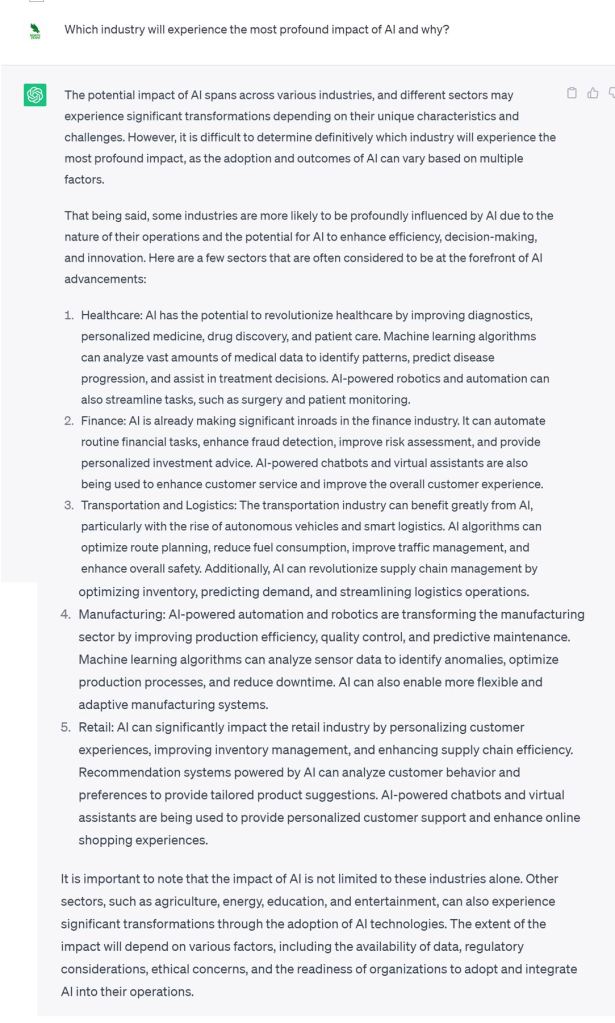
I posed Question 3 in ChatGPT and the provided response is below. Upon reflection, my initial response only considered one option, education. My response to Question 3 was thoughtful, and personal, and had two citations. The ChatGPT response provided was matter-of-fact and written without any emotional consideration. It could be argued that there was “no thought” given to the question; the chatbot was merely looking to provide a reply. In fact, the topic of Education didn’t even make the list on ChatGPT’s response. Yet, in the early days of this technology, education was the primary industry directly influenced by the introduction of ChatGPT. Perhaps the chatbot got lost in the definition of the question stem? Or perhaps it was just looking for an answer? Either way, the response was not thoughtful and did not connect with the course, or my personal viewpoint.
References
Bennett, G., & Cuevas, K. (2023, May 5). “Godfather of AI” discusses dangers the developing technologies pose to society. PBS. https://www.pbs.org/newshour/show/godfather-of-ai-discusses-dangers-the-developing-technologies-pose-to-society
Elayyan, S. (2021). The future of education according to the Fourth Industrial Revolution. Journal of Educational Technology and Online Learning, 4(1), 23–30. https://doi.org/10.31681/jetol.737193
Fenn, J. (2019, December 16). Ways education was affected by the Industrial Revolution. Medium. https://medium.com/@johnbfenn/ways-education-was-affected-by-the-industrial-revolution-78644198dec3
Gunnarsdottir, K., & Arribas-Ayllon, M. (2015, June 18). Ambient intelligence: A narrative in search of users (discussion paper). Lancaster EPrints. https://eprints.lancs.ac.uk/id/eprint/74291/
O’Brien, M. (2023, May 15). Watch: Openai CEO Sam Altman testifies before Senate Judiciary Committee. PBS. https://www.pbs.org/newshour/politics/watch-live-openai-ceo-sam-altman-testifies-before-senate-judiciary-committee
Rouhiainen, L. (2020). Artificial Intelligence: 101 things you must know today about our future. Lasse Rouhiainen.
Weiser, M. (1995). The computer for the 21st Century. Readings in Human–Computer Interaction, 933–940. https://doi.org/10.1016/b978-0-08-051574-8.50097-2
