PROMPT: Describe the methods you explored and how you decided your top choice is best aligned to your potential dissertation topic. Post this in your blog.
Like many scholars, I have been enthused and overwhelmed by the current state of technology innovations with the recent introduction of ChatGPT to the commercial market. The limitless potential of generative artificial intelligence, combined with the nature of the open-source code, will forever change the technological landscape we know today.
Earlier this week I found myself falling deep into the rabbit hole of profile pictures created by an artificial intelligence agent. I was in need of a professional profile picture for my work and social media accounts, however, I was looking for a low-cost photographer that could capture a professional image of me that brought out my personality and was taken in a casual setting. My search for this “gem image” started about a year ago. I researched poses on Pinterest, waited for my hair to be styled just right, tried to identify locations that were casual yet professional, and then searched for a professional photographer that wouldn’t blow my budget. Needless to say, the search stalled.
In my search for an appropriate topic for this week’s post, I came across a news article that mentioned how the author discovered an AI generator that created professional portraits. I was intrigued…and down the rabbit hole I went. I discovered ProfilePicture.AI, and for the low-low cost of $8.00, I was able to entertain myself with AI-generated images of myself. While many of the image styles available were related to fictional characters such as anime, cyborgs, elves, or video game heroes, there were a few styles available that one would consider to be “normal.” Businessman, cafe, corporate, office, tropical, and winter were viable options for a professional headshot.
As part of the creation process, I uploaded 20 pictures of myself that had been previously taken over the last 5-7 years. I cropped out anyone who may be in the image beside me, and I zoomed in on my face in any images where I was further in the distance. Once my 20 images were ready, I uploaded them, selected my ideal styles, paid my $8.00, and waited. The inputted photos train the AI software to generate an appropriate output that accurately represents the user’s inputted images. A few hours later the program finished rendering my images and provided me with 116 unique profile pics that mostly looked like me.

This experience was quite fun, and although the sample collage above does not display all 116 images, I did include a few fun options of me as an astronaut and as Valkarie.
As I reflected on the potential of this technology, and knowing that it is in its infancy, I wondered if there could potentially be a research study that aligned with this fun tool. I research advanced qualitative research methods such as arts-based research, focus groups, usability testing, but these did not seem to align. Thus, I deflect back to a more traditional qualitative method of interviewing.
Yet, in this case, I am not sure that a solely qualitative research collection method would be sufficient and therefore I designed a mixed-methods research study for this research scenario. The mixed-method study would include a quantitative survey to collect confidence levels and trustworthiness of AI-generated images. A brief qualitative interview will be conducted following the survey completion, designed to gauge the participant’s feelings towards their ability to identify an AI-generated image, their feelings of deception as it relates to AI-generated images, factors that influence trust in an AI-generated image, and their feelings towards creator-transparency as it relates to AI-generated images. At the end of the survey, the participants will be asked to upload 20 face-pictures of themselves into a database maintained by the researcher. The researcher will preview the images and prepare them for the AI-generator software process by cropping any extra persons in the photo, as well as zooming in on any face pictures that are in the distance, before uploading them to ProfilePicture.AI. In the following one-to-two weeks, the participants will return to answer the same interview questions as they did prior; however, this time, they will be provided their AI-image renderings prior to the second instance of the interview. The interview responses will be evaluated to identify any changes pre-and-post receiving the AI-generated images of themselves. See the research method outline below:
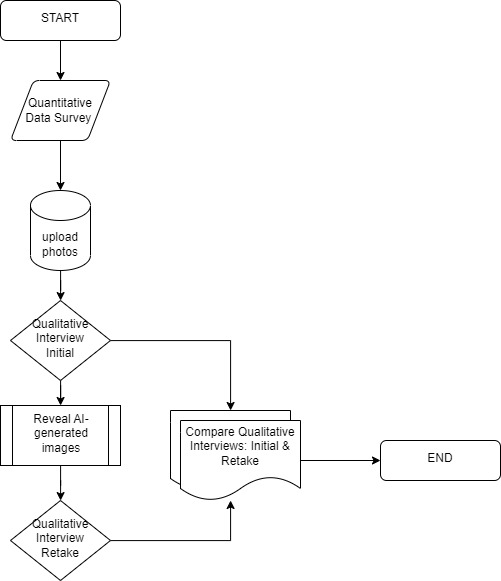
In the end, I would expect that the qualitative interview responses will have changed between the pre-and-post interviews. I expect to see increased apprehension in their feelings of deception as it relates to AI-generated images, as well as trust factors for an increased number of online images. Additionally, I expect participants to express increased advocacy for creator-transparency of online images.
Research on this topic is slow in comparison to the lightning speed that the technology is advancing. Additional research needs to be conducted within the published literature to provide a foundation of support for this research topic.

One thought on “6516: Week 4 – Reflection”
Comments are closed.